



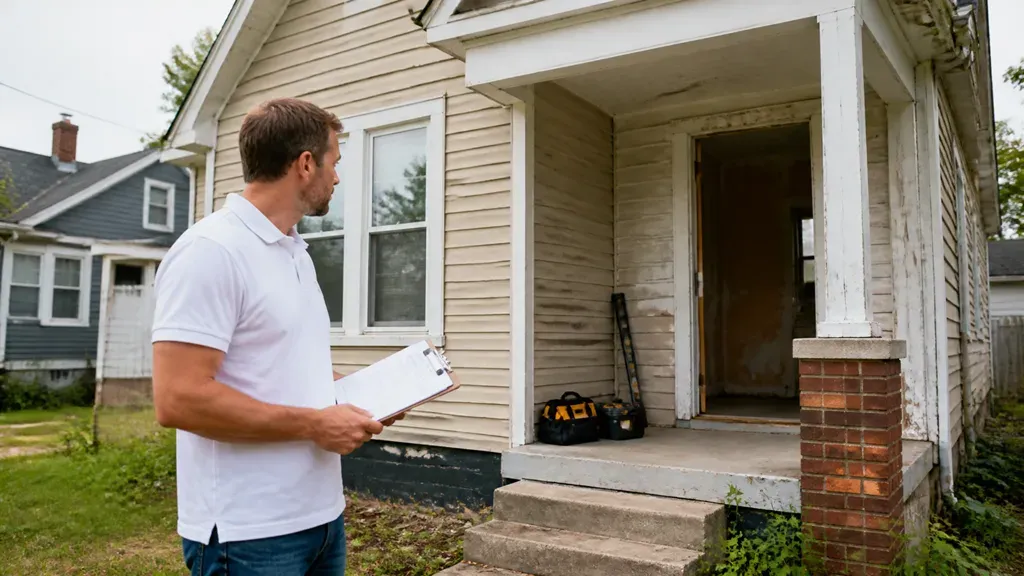
4 Tips to Flip a House in Indianapolis
These four tips cover the complete arc of a house flip in Indianapolis - from setting up your operation through finding deals, renovating strategically, and exiting profitably. Each tip reflects the specific dynamics of the Indianapolis and Central Indiana market rather than generic advice that could apply anywhere in the country.
Tip 1: Build Your Indianapolis Flip Team Before You Need Them
Flipping a house is a team sport. The investors who try to manage every aspect solo - finding deals, negotiating purchases, overseeing contractors, managing the sale - burn out quickly or make costly mistakes by spreading their attention too thin. The investors who scale successfully in Indianapolis are the ones who build reliable professional relationships before they close their first deal.
The core team for an Indianapolis house flip:
- General contractor or renovation manager: Your most critical relationship. A contractor who understands flip economics - who scopes to the spec level appropriate for the neighborhood, completes work on timeline, and does not create change orders for every minor discovery - is worth more than any deal you will ever find. Interview multiple contractors before committing; ask for references from investors (not homeowners) specifically; and verify license and insurance through the Indiana Professional Licensing Agency before any contract is signed.
- Real estate agent with investor experience: An agent who primarily works with homebuyers will not serve your interests as a flipper. You need an agent who understands deal underwriting, can run tight ARV analyses, has relationships with wholesalers and off-market sellers, and can list finished flips with the urgency and marketing focus your business requires.
- Private money lender or hard money lender: Most Indianapolis flips are funded through short-term financing rather than conventional mortgages. Establish relationships with private lenders before you need capital. Know their rates (typically 10-14% annually), points, and draw schedule processes. Having a committed lender when a deal materializes is the difference between moving and missing it.
- CPA familiar with real estate investor taxation: Flipping income is taxed as ordinary income, not capital gains. A CPA who understands the distinction, knows depreciation and cost-segregation strategies applicable to your specific situation, and can help you structure your business entity correctly saves far more than their fee costs.
Build these relationships before you need them. Having a contractor, lender, and agent who know how you work allows you to move on deals quickly - and in the Indianapolis off-market property world, speed is often the deciding factor between winning a deal and losing it to another investor.
A secondary team layer that experienced Indianapolis flippers also develop: a title company or real estate attorney who handles investor transactions routinely and can close quickly when needed; an insurance agent who can place vacancy or renovation policies within 24 hours; and a property manager contact in case a flip timeline extends and a tenant becomes a short-term holding strategy. None of these are needed every deal, but when they are needed, having the relationship saves weeks.
Tip 2: Know How and Where to Find Undervalued Property in Indianapolis
The era of finding flippable Indianapolis properties on the MLS for significantly below market value has largely passed. While occasional MLS deals do exist - particularly distressed listings that have been on the market for extended periods - the most reliable deal flow for Indianapolis flippers comes from off-market channels.
The good news: Indianapolis has a robust supply of older housing stock - particularly homes built between the 1940s and 1980s on the east, west, and south sides of Marion County - that continues to produce flip opportunities for investors who know where to look. Primary deal sources for Indianapolis flippers:
- Wholesale networks: Indianapolis has an active wholesale market. Wholesalers - investors who find distressed properties and sell purchase contracts to other investors for an assignment fee - are a significant source of flip inventory. Build relationships with active Indianapolis wholesalers and get on their buyer lists. Be clear about your buy box (price range, neighborhood, condition tolerance) so they contact you when relevant deals come through.
- Probate and estate sales: Indiana probate (governed by IC 29-1) regularly produces properties that heirs want to sell quickly and without the burden of renovation. These properties often sell below market because heirs are motivated by speed and simplicity rather than maximizing price. Building relationships with probate attorneys in Marion, Hamilton, Hendricks, and Johnson counties can produce consistent deal flow.
- Direct mail and outreach: Targeted campaigns to absentee owners, properties with delinquent taxes, or homes with code violations in specific Indianapolis sub-markets can generate motivated seller leads. This requires consistent investment and follow-up, but produces off-market deals without wholesale assignment fees.
- MLS distressed listings: Homes listed as-is, with extended days-on-market, or with price reductions are worth monitoring. A property that has sat for 45 days at an overstated price may be an opportunity at a lower negotiated price that still works within your flip formula.
Sellers in Pittsboro in Hendricks County and surrounding communities who are motivated to sell quickly often reach out directly to investors like Chris Buys Homes Indy, creating deal flow that benefits both the seller who needs speed and the investor who needs inventory.
Tip 3: Know Your Buyer Profile Before You Renovate
Every renovation decision you make during a flip should be filtered through one question: what does the buyer who will purchase this home actually want? The answer differs significantly across Indianapolis sub-markets, price ranges, and neighborhoods - and getting it wrong costs you money in two ways: over-spending on improvements buyers do not value, and under-delivering on features buyers do prioritize.
Indianapolis buyer profiles by segment:
- First-time buyers (under $200,000): This buyer needs functional and move-in ready above everything else. They are typically stretching financially and cannot absorb immediate repair costs. Focus on clean condition, functional systems, safe electrical and plumbing, and a fresh appearance. They do not pay extra for granite countertops in this price range; they pay for confidence that they will not have a furnace failure in their first winter.
- Move-up buyers ($200,000-$350,000): This buyer is comparing your flip to other renovated homes in the same price band. They evaluate finish quality more critically than the first-time buyer and notice when builder-grade fixtures are used in a price range that supports better. Kitchen and bathroom finish quality drives this buyer’s decision more than any other factor.
- Hamilton County/suburban buyers ($350,000+): School district is the primary driver for this buyer. If your flip is not in a desirable school district, the price ceiling is lower regardless of finish quality. If it is in a desirable district, this buyer will pay a meaningful premium for the right combination of location and updated condition.
Before you finalize your renovation scope, walk the neighborhood and look at what comparable renovated homes offer. If every comparable has LVP flooring throughout and updated fixtures, meeting that standard is the floor - not a premium. Falling below the neighborhood renovation standard invites price pressure; exceeding it in ways buyers do not value wastes margin.
One practical exercise: walk through three or four competing listings in the same neighborhood before you finalize your renovation spec. What finishes do they have? What is the kitchen style? What flooring? This exercise tells you exactly what the market expects at this price point in this area, which is more useful than any general renovation guide. Then match or slightly exceed that standard in your highest-visibility areas (kitchen, primary bathroom, curb appeal) and meet it everywhere else. That is the renovation approach that produces the best price-to-cost ratio consistently.
Tip 4: Move Quickly and Manage Time Intentionally
Time is the variable that most directly controls profitability on an Indianapolis flip. Every week a project runs longer than planned costs you carrying costs - hard money interest, taxes, insurance, utilities - that come directly out of your margin. A flip that was projected at $35,000 in profit and runs eight weeks over timeline can see $6,000-$12,000 of that margin evaporate in carrying costs alone.
Speed management starts before construction begins. Before you close on a flip property, have your renovation scope fully developed, your contractor committed with a start date, and your materials list ready to order. The period between closing and contractor start is wasted time - in some cases, materials can be ordered before closing so work can begin day one.
During renovation, hold your contractor to the project schedule with milestone-based payment draws. Each payment release should be tied to verifiable completion of a defined scope phase, not to calendar dates. A contractor who knows the next payment depends on completing rough work by a specific date has accountability that calendar-based payments do not provide.
On the listing side, have your agent, photographer, and stager ready to move the moment renovation is complete. A two-week delay between renovation completion and listing because you are coordinating these relationships costs you two weeks of carrying costs for no reason. Schedule them in advance so you go live within days of completion.
Pricing at listing is also a speed decision. A flip priced at the competitive midpoint of recent comparables typically generates offers within 10-14 days. A flip priced at the top of the range may sit for 30-45 days before a price reduction is required - and by then, the additional carrying costs have consumed a significant portion of whatever premium the higher price was attempting to capture. Speed and correct pricing are not in conflict; they reinforce each other. The fastest sales consistently come from homes priced at or just below the market center, not above it.
Sellers in Whiteland in Johnson County and investors working throughout Central Indiana who have systematized their flip operations consistently report that the time savings from preparation - having contractors, lenders, agents, and photographers committed before they are needed - compound into significant profit improvements across multiple projects per year.
Starting With a Direct Purchase
For investors who are just beginning to build their Indianapolis flip pipeline, Chris Buys Homes Indy is an active buyer of distressed properties throughout Central Indiana. If you are a seller in a situation where speed matters more than maximizing sale price - or an investor looking to understand how direct purchase transactions work from the seller side - call (317) 526-4712 or reach out through our site at contact-us to get a written cash offer within 24 hours.
Selling in Wilkinson in Hancock County or anywhere throughout the Indianapolis metro, the process is straightforward: no renovations required, no showings, no financing contingencies. For the right seller, it is the most direct path to a fresh start - and for investors, it is how you source properties that no one else is competing for.